Bland Diet Alternatives When You're Out of Chicken
Medically reviewed by Roger Clemmons, DVM, PhD, DACVIM (Neurology and Neurosurgery), CVA, CVFT — For general education — not a substitute for veterinary care.
Out of chicken and your dog's stomach is off? Turkey, white fish, or lean beef can do the same job, done the right way.
On this page
It’s almost always 9pm on a Tuesday. You’ve decided to make the bland diet — rice, some protein, maybe a little pumpkin — and then you open the freezer and there’s no chicken. Just a bag of frozen peas and a rotisserie carcass from three weeks ago that isn’t going anywhere near your dog’s bowl. This is the fork most owners hit: do you drive to the store at 9pm, or do you work with what’s actually in the kitchen?
You can work with what’s in the kitchen. Chicken isn’t magic. It’s just lean, mild, and familiar, which happens to describe two or three other proteins sitting in most refrigerators.
What “bland” is actually asking for
A bland diet isn’t a specific ingredient list — it’s a job description. Low fat, easy to digest, low in fiber and spice, gentle enough that a gut that’s already irritated doesn’t have to work hard. Chicken breast checks those boxes, but so does 93%-lean ground beef, cooked white fish like tilapia or cod, or plain low-fat cottage cheese. The through-line is fat content and simplicity, not the specific animal.
In my practice I see this mistake constantly: an owner swaps chicken for chicken thigh instead of chicken breast, or reaches for ground beef that’s 80% lean instead of 93%, and the dog’s stool gets looser instead of better. The protein source matters less than the fat content sitting inside it. I had a twelve-year-old Cavalier King Charles Spaniel, about 16 pounds, whose owner called on a Sunday morning because he’d had two loose stools overnight after getting into the trash. She didn’t have chicken breast in the house, only 85% lean ground beef and a can of plain pumpkin. I walked her through draining the fat completely, blotting it with a paper towel, and pairing it 1 with plain white rice instead of the usual 2 rice-heavy ratio she’d used with chicken before — because the beef, even lean, still carried more fat than chicken breast would have. By Tuesday his stool was formed again and his appetite, which had dipped that first day, was back to normal.
The swaps that actually work
- Turkey breast (skinless, boiled or baked, no seasoning) — closest match to chicken in fat and texture.
- White fish (tilapia, cod, or sole, plain-cooked) — very low fat, easy on a sensitive gut, good if your dog’s had chicken-protein reactions before.
- Low-fat cottage cheese — useful in small amounts, especially for a dog who’s picky about texture during a flare-up.
- Extra-lean ground beef (93% or leaner), fat drained and blotted — works, but needs closer fat management than turkey or fish.
Pair any of these with plain white rice, usually at a 2 rice-to-protein ratio unless the protein itself carries more fat, in which case lean the ratio further toward rice. A spoonful of plain canned pumpkin helps too: pumpkin fiber is a gentle, natural source of both soluble and insoluble fiber, which is exactly the texture you want stool to have while a gut settles.
Where I actually land, and the counterargument I take seriously
I’ll say plainly what I tell owners on the phone: turkey breast is my default second choice after chicken, and white fish is my choice for a dog who’s had gut trouble on poultry before. That’s not a hedge — it’s the recommendation. The counterargument I hear most is that any diet change during a GI upset is risky, that you should just fast the dog and wait it out. I don’t think that holds up well for most healthy adult dogs with routine, mild GI upset. A short bland-diet bridge, built on a protein you actually have on hand, keeps intake and hydration going without adding fat the pancreas has to work around. Where I do agree with the skeptics is timing — this approach is for a dog who’s otherwise bright, eating some, and not vomiting repeatedly. That’s a different animal, clinically, from one who needs to be seen.
This is also where the gut stops being “just digestion” in my mind. I trained through Western neurology, but food therapy from traditional Chinese veterinary medicine has shaped how I think about a settling gut just as much as any imaging study has. The enteric nervous system talks to the brain constantly, and a dog whose stomach has calmed down usually sleeps better and paces less that same night — which is often the first thing an owner actually notices, before the stool ever normalizes.
If the underlying issue is something more structural than a one-off dietary indiscretion — a dog with chronic pancreatitis, or Journal of the American Veterinary Medical Association: exocrine pancreatic insufficiency — bland-diet swapping at home isn’t the fix. EPI in particular is treated with pancreatic enzyme replacement therapy, nutritional management using low-residue diets with moderate fat content, and cobalamin supplementation, all of which needs a veterinarian’s oversight, not a kitchen substitution.
What to leave out of the bowl
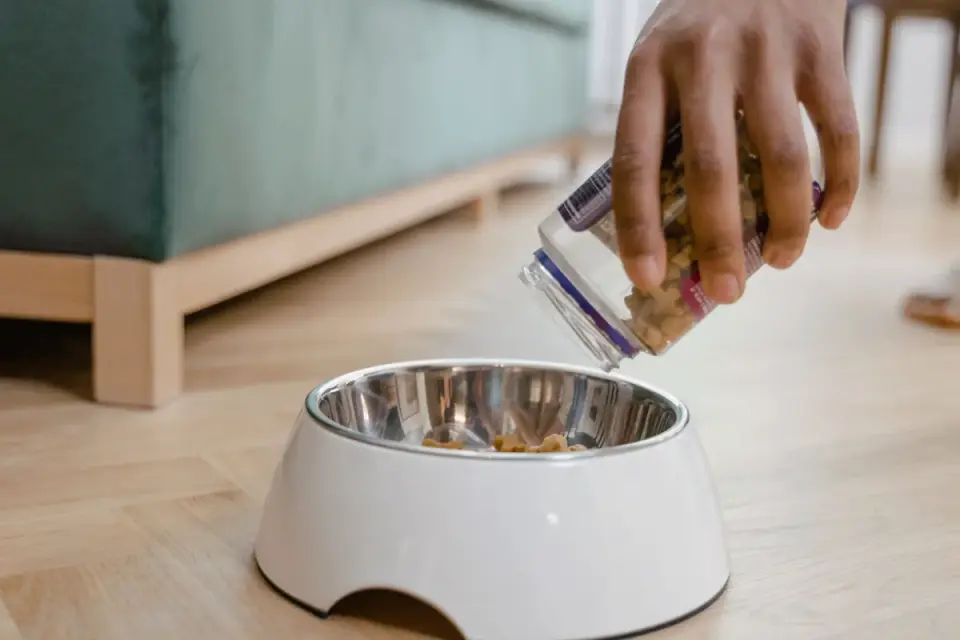
No butter, no oil, no seasoning, no onion or garlic — not even trace amounts in a broth or bouillon cube, which is a mistake I still see owners make when they’re trying to add flavor to encourage a picky eater to finish the bowl. Onions are toxic to dogs at any dose, cooked or raw, and a bland-diet moment is exactly when an owner reaches for a flavor boost without thinking it through. Skip dairy beyond a small amount of plain cottage cheese, and skip high-fiber fruit swaps like apples or bananas during an active flare — they’re fine dogs generally, just not what a sensitive gut needs mid-upset.
If probiotics are already part of your dog’s routine, this is a reasonable moment to lean on them. A balanced gut microbiome supports overall immune function, though a recent controlled trial in dogs published in Frontiers in Veterinary Science found that diversity metrics alone didn’t distinguish which dogs responded to probiotic treatment from those that didn’t — a reminder that probiotics are a supporting player here, not the whole plan, and results vary dog to dog.
When this stops being a kitchen problem
Call your vet if the loose stool hasn’t firmed up in 48 hours on the bland diet, if there’s blood, repeated vomiting, or a dog who’s lethargic instead of just a little quieter than usual. I think about the Cavalier’s case again here — his owner knew the line because we’d talked about it before: eating some, drinking, still greeting her at the door. If any of those had flipped the other direction, the plan would have changed immediately, chicken or no chicken.
The short version: chicken isn’t the ingredient that matters, low fat and simplicity are. Turkey breast or plain white fish are the closest substitutes, lean ground beef works if you manage the fat carefully, and pumpkin and rice round out the plate. Give it 24 to 48 hours to work, and call your vet if it doesn’t.
Frequently asked questions
Can I use ground beef instead of chicken for a bland diet?
Yes, if it's 93% lean or leaner, with the fat drained and blotted off. Fattier beef can make loose stool worse, not better.
Is turkey a good chicken substitute for a dog's bland diet?
Turkey breast, boiled or baked with no seasoning, is one of the closest matches to chicken for fat content and digestibility.
How long should a dog stay on a bland diet?
Usually 24 to 48 hours, then transition back to regular food gradually over another 2 to 3 days. If it's not helping by 48 hours, call your vet.
Sources
- Diagnosis and management of exocrine pancreatic insufficiency in dogs and cats — Journal of the American Veterinary Medical Association
- Probiotic response variability study in dogs — Frontiers in Veterinary Science